Adrian Piper claims that we errantly fetishize art objects if we see them as unique, their spatio-temporal locations and histories not amounting to a full-fledged "identity, and their putative power to influence us a mere reflection of our own displaced capacities. Human beings, that is, are alone inherently creative, "alive," and non-reproducible. Her complaint with fetishism is Marxist in spirit (as he applies the concept to commodities and economic "laws"), though I suspect that the impulse to fetishize in aesthetics (as in human sexuality and religion), while clearly an epistemological and metaphysical error (the object of our fetish does not in fact possess the properties we ascribe to it), is relatively harmless. We oftentimes willingly submit to exaggerated or false accounts of the nature of art objects in order fully to appreciate their aesthetic dimension. (We "lose" ourselves in a novel, for example, tacitly attributing to its characters and setting more reality and power than they possess.)
It may be that Piper would not count these as legitimate examples of fetishism in art (because we are at least partly aware of our impulse to fetishize). At any rate, the very idea of fetishism seems to lose much of its force when transferred from the life-and-death realm of political economy to the highly subjective world of art.
DKJ
Thursday, November 30, 2006


Friday, November 17, 2006
The Possibility of Benign Envy
Envy, like jealousy, is a triadic relation, as both involve a subject, a rival, and a good (where the difference between the two amounts to a shifting locus of concern from envy of the rival to jealousy of the good.)
The entry on envy in the Stanford Encyclopedia of Philosophy touches on the possibility of a benign, admiring form of envy designed solely to secure for the subject (S) some good (G) possessed by a rival (R) (in contrast to the more commonplace invidious, malicious envy that involves undermining the rival). In other words:
S is benignly envious of R if he/she hopes merely to possess G
and
S is invidiously envious if he/she hopes to relieve R of G.
Let's say I'm envious of a colleague's publication record. My envy remains emulative and apparently benign so long as I act only to match or exceed ("outdo") my colleague's record (perhaps I publish as much, more, or works of better quality than my colleague). In contrast, my envy is invidious to the extent that I act to undermine ("undo") my colleague's record (perhaps, though I fail to improve my own publication record, I labor systematically to critique or belittle my colleague's accomplishments).
While the second form of envy is clearly unacceptable, is the first entirely benign?
DKJ
The entry on envy in the Stanford Encyclopedia of Philosophy touches on the possibility of a benign, admiring form of envy designed solely to secure for the subject (S) some good (G) possessed by a rival (R) (in contrast to the more commonplace invidious, malicious envy that involves undermining the rival). In other words:
S is benignly envious of R if he/she hopes merely to possess G
and
S is invidiously envious if he/she hopes to relieve R of G.
Let's say I'm envious of a colleague's publication record. My envy remains emulative and apparently benign so long as I act only to match or exceed ("outdo") my colleague's record (perhaps I publish as much, more, or works of better quality than my colleague). In contrast, my envy is invidious to the extent that I act to undermine ("undo") my colleague's record (perhaps, though I fail to improve my own publication record, I labor systematically to critique or belittle my colleague's accomplishments).
While the second form of envy is clearly unacceptable, is the first entirely benign?
DKJ
Wednesday, November 15, 2006
A = A-ity + IR = I sub-a + A-ity?
We suggested today that Dickie offers the following intensional definition of art in response to Weitz's claim that art is indefinable-because-open:
A = A-ity (Artifactuality) + IR (Institutional Recognition)
where the institution is the "artworld;" artifacts include all of the deliberate material (and perhaps cognitive) products of human activity; and where recognition occurs as any person functioning as a member of the artworld confers on some artifact the (descriptive and evaluative) status of "artwork."
Dickie presents his definition of art as open-yet-definable (A-ity and IR are necessary and jointly sufficient conditions for anthing to count as a work of art). I suppose that the raison d' etre of all such (intensional) definitions is to expose the essence of works of art, allowing us to distinguish works of art from all other things. Yet, failing as he does to offer any criteria for either membership in the artworld or proper (objective) institutional recognition or assessment, anyone and for any reason can confer on any human artifact the status of "artwork." It seems as though Dickie's definition of art is no more exclusive than the simple claim that all artifacts are works of art, so long as someone intends them to be. That is, Dickie's definition is equivalent to the rather unhelpful-because- excessively-inclusive "Intentionality Thesis" (art exists whenever somone intends it) applied within the realm of the artifactual. In short:
A = I-sub-a (where a is anyone) + A-ity
Hence
A = A-ity + IR = I sub-a + A-ity
Capturing as well (by eliminating from both expressions A-ity) the fact that
IR = I sub-a.
Comments always welcome,
DKJ
A = A-ity (Artifactuality) + IR (Institutional Recognition)
where the institution is the "artworld;" artifacts include all of the deliberate material (and perhaps cognitive) products of human activity; and where recognition occurs as any person functioning as a member of the artworld confers on some artifact the (descriptive and evaluative) status of "artwork."
Dickie presents his definition of art as open-yet-definable (A-ity and IR are necessary and jointly sufficient conditions for anthing to count as a work of art). I suppose that the raison d' etre of all such (intensional) definitions is to expose the essence of works of art, allowing us to distinguish works of art from all other things. Yet, failing as he does to offer any criteria for either membership in the artworld or proper (objective) institutional recognition or assessment, anyone and for any reason can confer on any human artifact the status of "artwork." It seems as though Dickie's definition of art is no more exclusive than the simple claim that all artifacts are works of art, so long as someone intends them to be. That is, Dickie's definition is equivalent to the rather unhelpful-because- excessively-inclusive "Intentionality Thesis" (art exists whenever somone intends it) applied within the realm of the artifactual. In short:
A = I-sub-a (where a is anyone) + A-ity
Hence
A = A-ity + IR = I sub-a + A-ity
Capturing as well (by eliminating from both expressions A-ity) the fact that
IR = I sub-a.
Comments always welcome,
DKJ
Monday, November 13, 2006
Turkeys of the World Unite

On Turkey Day
Alongside our symbol of freedom she ranks.
Regard for her grows as we near “Turkey Day.”
(I’ll parse her death as “regard,” if I may.)
Are turkeys the victims of vile human power?
A simpering few harbor thoughts fairly dour:
“These birds live their lives in a self-conscious way;
These birds aren't for stuffing, or eating,” they say.
Don't people agree that tradition's a right;
One sufficiently strong to eclipse the bird’s plight?
Perhaps they’re just bored, confused, or hate cooking;
It’s only a bird (and rather ill-looking).
Those in the know limit thought to our brains:
Alone we can suffer, feel pleasures and pains.
Just meeting our needs – a formidable feat;
How dreary the world, each entrée sans meat!
Life’s like a raft, with but room for one kind;
(And -- tofu be damned -- they're too simple to mind.)
The turkey we honor on this day of thanks;
Alongside our symbol of freedom she ranks.
DKJ
Wednesday, November 08, 2006
Definability and Openness
Morris Weitz claims that art is an indefinable-because-open concept. I tentatively suggested today that he conflates indefinability and openness, overlooking in the process the possibility of a definable-yet-open conception of art.
Weitz -- or perhaps Wartenberg -- apparently assumes that a satisfactory definition of art must be an intensional one (a specification of the necessary and jointly sufficient conditions required of each member of the set under consideration). But Weitz's preferred extensional (in this case, ostensive) definition of art is still, obviously enough, a definition.
Even so, I remain hopeful that we might construct a satisfactory -- however inclusive and broad -- intensional definition of art. See Jeff Strayer's handout for a brief summary of the relations between necessary and sufficient conditions and the attempt to define art.
Comments always welcome,
DKJ
Weitz -- or perhaps Wartenberg -- apparently assumes that a satisfactory definition of art must be an intensional one (a specification of the necessary and jointly sufficient conditions required of each member of the set under consideration). But Weitz's preferred extensional (in this case, ostensive) definition of art is still, obviously enough, a definition.
Even so, I remain hopeful that we might construct a satisfactory -- however inclusive and broad -- intensional definition of art. See Jeff Strayer's handout for a brief summary of the relations between necessary and sufficient conditions and the attempt to define art.
Comments always welcome,
DKJ
Monday, November 06, 2006
Stabbing at the Heart of Heartlessness
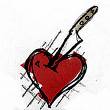 Marx's famous suggestion that religion is the "opium" of the people is no mere condemnation of the impulse to find comfort in otherworldly entities and places. Rather, he both condemns religion (as a condition that requires illusions) and congratulates it (as a protest against and expression of real suffering that can offer a glimpse into the "heart of a heartless world"). In the end, however, religion-qua-opiate simply masks symptoms of -- and hence reinforces -- the underlying social/political/earthly disease. I'll quote in full the passage we considered from his "Contribution to the Critique of Hegel's Philosophy of Right":
Religious suffering is, at one and the same time, the expression of real suffering and a protest against real suffering. Religion is the sigh of the oppressed creature, the heart of a heartless world, and the soul of soulless conditions. It is the opium of the people.
The abolition of religion as the illusory happiness of the people is the demand for their real happiness. To call on them to give up their illusions about their condition is to call on them to give up a condition that requires illusions.
The criticism of religion is, therefore, in embryo, the criticism of that vale of tears of which religion is the halo.
Criticism has plucked the imaginary flowers on the chain not in order that man shall continue to bear that chain without fantasy or consolation, but so that he shall throw off the chain and pluck the living flower. The criticism of religion disillusions man, so that he will think, act, and fashion his reality like a man who has discarded his illusions and regained his senses, so that he will move around himself as his own true Sun. Religion is only the illusory Sun which revolves around man as long as he does not revolve around himself.
It is, therefore, the task of history, once the other-world of truth has vanished, to establish the truth of this world. It is the immediate task of philosophy, which is in the service of history, to unmask self-estrangement in its unholy forms once the holy form of human self-estrangement has been unmasked.
Thus, the criticism of Heaven turns into the criticism of Earth, the criticism of religion into the criticism of law, and the criticism of theology into the criticism of politics.
Comments always welcome,
DKJ
Friday, November 03, 2006
Insignificant Form
Circularity seems to be the logical defect de jour.
According to “formalist” Clive Bell, all and only those objects with significant form are art. But what makes some forms (combinations of lines, shapes, and colors) significant? Here is Bell's answer:1. We know significant form by its effect on us: it evokes (in the ideal observer), a “peculiar” aesthetic emotion. Yet,
2. We know these aesthetic emotions only as those triggered by our observation of significant form.
Unfortunately,
All and only those objects with some unknown property are art.
Or
All and only those objects that evoke some unknown aesthetic emotional reaction are art.
Comments always welcome,
DKJ
Subscribe to:
Posts (Atom)